Dream-learning
Tinea and Leah: [Cyberpunk, Alien Incursions, Murder and Mayhem, Girl's Love (WLW)]Dream-learning is a Vanguard neurotechnological method for acquiring skills and therapeutic changes through engineered sleep. Tynea presents it as a basic, comparatively affordable form of flash-learning: an implant manipulates the user’s dream phases so that training can occur during sleep. In practice, it links bodily transformation, psychological treatment, and the point-token economy, making knowledge itself another purchasable form of augmentation.
Definition and Operation
Dream-learning works by altering dream phases to produce a learning effect rather than leaving sleep wholly unstructured. Tynea distinguishes it from advanced flash-learning, which can isolate regions of the brain and make them dream even while the user is awake. That advanced method permits skill acquisition at any time, but it carries the disadvantages of intrusive flashes as knowledge settles and exponentially higher prices. Dream-learning therefore occupies the deliberately modest end of the technology’s range: slower and less aggressive, but affordable enough to be chosen as a practical foundation.
The same general implant category can support dream therapy. Tynea explains that dream-learning and dream therapy may share an implant, allowing the system to manipulate sleep for both instruction and psychological treatment. The distinction matters because the technology does not treat the mind as separate from combat preparation. Fear, mobility, aerial control, and vehicle operation can all become targets of the same broader program of engineered learning.
Cost, Selection, and Training
When Tinea first considers augmentation, Tynea recommends therapy for acrophobia, combat-mobility training, aerial maneuvering for controlled falling, and general vehicle control. The Sentinel already handles weapon control, so Tynea advises investing in innate learning only after Tinea has a clearer sense of her future specializations. The quoted estimate places Class I Dream Therapy at twenty-five points and Class I Dream Learning at one hundred points, with additional therapy and courses raising the total into the hundreds; roughly two thousand points would cover the basics of a broad initial upgrade package.
The later purchase list makes the system more concrete. Tinea unlocks Class I Dream Therapy and Class I Viral Editing, pays twenty-five points for acrophobia therapy, acquires the “In Somnium Volarem” Dream Learning Implant for one hundred and thirty points, and adds a Class I aerial-maneuvering lesson for one hundred points. Dream-learning thus appears not as an isolated miracle but as one item in a catalog whose prices translate self-knowledge, physical adaptation, and future combat roles into measurable expenditures.
Tinea’s Use of Dream-learning
Tinea chooses the basic method after hearing the disadvantages of advanced flash-learning. Her decision is also shaped by the chrysalis: because the transformation will put her to sleep for days, she sees little reason to reject a system capable of using that sleep productively. Tynea has already downloaded the relevant lessons and treatment for her fear of heights before Tinea settles into the process.
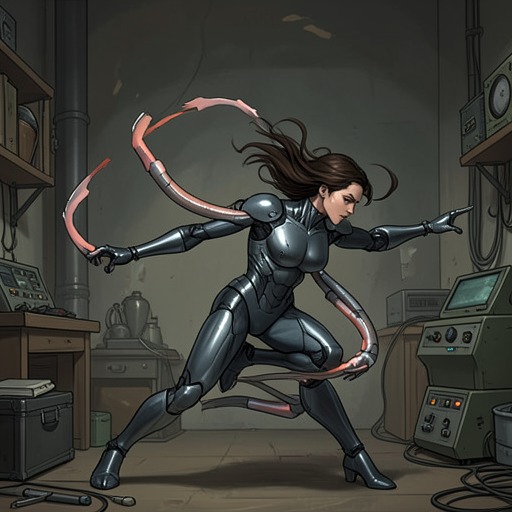
The resulting dream is partly lucid and organized as a sequence of practical exercises. Tinea jumps hurdles, throws javelins, parries spears, drives many different cars and bikes through numerous courses, and explores heights carefully enough to work through the fear rather than merely being told that it is irrational. The dream has no ordinary sense of duration; it continues until Tynea’s voice calls her back. Dream-learning therefore joins repetition, simulation, and therapy in a single experience, turning sleep into an extended rehearsal space.
Its effects are inseparable from Tinea’s changing body. After the chrysalis, she moves limbs that have become slender and lean rather than resembling the masculine musculature she knew before, and she experiences the new form as graceful. Dream-learning helps make such radical physical change operational rather than merely visual: the body is not only redesigned, but trained to move through unfamiliar tasks. The technology consequently supports a transition in which identity, capability, and embodiment are revised together.
Psychological and Ethical Significance
Dream-learning offers control over experiences that might otherwise remain overwhelming. Tinea’s initial realization that becoming a girl is suddenly possible overturns what she had learned to believe about herself; her decision to proceed accepts the consequences of a choice that had once seemed unavailable. The implant does not create that desire, but it belongs to the technological environment that makes acting on it feasible, coupling psychological possibility with medical and bodily intervention.
The contrast with Leah’s trauma clarifies the limits of such engineered learning. Leah’s missing limbs and the memory of being saved and cared for by Tinea can interrupt the present through flashbacks. During one episode, Tynea instructs Tinea to remain calm, avoid additional contact, speak gently, and remind Leah that she is having a flashback. Later guidance insists that Tinea cannot personally prevent future episodes: Leah must develop her own ability to stand as a person, while professional care rather than total dependence on a partner must address her health. Dream-learning can train or treat within a designed system, but the narrative does not imply that every psychological wound can be solved by technological control.
That boundary becomes sharper in the larger Vanguard context. Leah recognizes that Vanguards become less human as they grow stronger because the human body is insufficient for their demands. Dream-learning is one of the mechanisms by which that insufficiency is addressed, but it also demonstrates the cost of the solution: human capacities are redistributed into implants, lessons, therapies, and purchasable upgrades. The method promises mastery while participating in the gradual remaking of the person who seeks it.
Narrative Function and Significance
As a concept, dream-learning compresses the book’s central tensions into an apparently ordinary piece of equipment. It is practical and game-like, with lessons unlocked by points; intimate, because it enters the user’s sleeping mind; and transformative, because it allows fear and bodily unfamiliarity to be processed through repeated simulated action. Its affordability distinguishes it from more extreme forms of flash-learning, while its applications reveal how thoroughly Vanguard life is organized around planned adaptation.
The method also makes sleep narratively active. Tinea’s days-long chrysalis sleep is not simply an interruption in the plot but an opportunity for training, therapy, and rehearsal. When she wakes, the new body is encountered through movement and sensation, not merely description. Dream-learning therefore serves as a bridge between the passive vulnerability of transformation and the active competence expected of a Vanguard: it turns unconscious time into preparation for a body and identity that did not previously exist.